Pathfinding to Novelty
Published 9 months ago
Golem Mancer
So running prototypes and experiments on my Golem Mancer enemy A.I has proven to be an even more interesting endeavour than I initially thought.
To be brief, the planned implementation would have the Enemy A.I appears to learn and adapt to the players strategies with each difficulty level accentuating the effect of the A.I..
In conducting research into how this kind of system would be implemented I couldn't find an existing parallel. Certainly there are many more sophisticated enemy AI's to chose from but a truly similar A.I was impossible to find any information on.
One word to describe it would be, disheartening. On the one hand I may have stumbled on to a totally novel approach to enemy AI and I'll be building without the safety net of a reference material. On the other hand the absence of any other existing implementations could be a sign that its not a feasible way to design a game's A.I.
That raises the question what existing models could co-op to make the A.I magic happen. What I settled on is A* path-finding, with some slight eccentricities of course. Rather than treating the pathing as an issue of position but rather proximity to a mathematically ideal.
Given the context of the A.I its pathing is comprised of two digital sense organs. One is the visual range. the A.I cannot see all of the obstacles between itself and the goal so it relies on its visual field of view. it moves then recalculates if the obstacles are updates (rephrase)
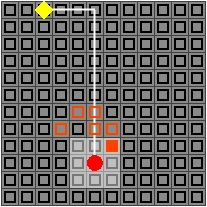
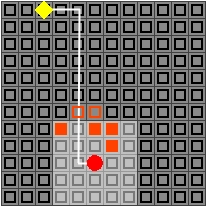
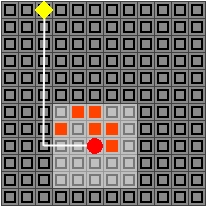
The second apparatus the A.I is its learned memory. Between rounds the cumulative experience is expressed as learned recognition of types obstacles. This truncates the effectiveness of any single type of obstacle//any given strategy over time.
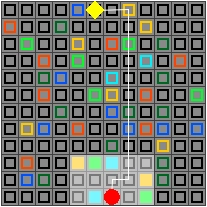
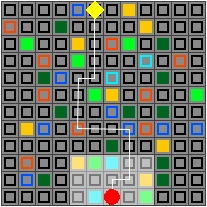
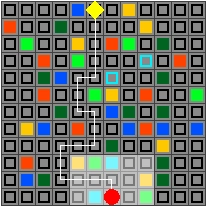
This is an overly simplified view of the process and results, with the ultimate goal being a level of complimentary complexity between player strategy and A.I strategy. There'd be a matching response for each of the player's tactics making the path-finding more about the number of dimensions rather than individual complexity.
Tower goblins -> Grounds goblins Catapult speed -> Catapult Force Regular Archers -> Fire Archers Regular Archers -> Ice Archers Regular Archers -> Toxin Archers
Axis would represent balancing of enemy force production for aspects like;
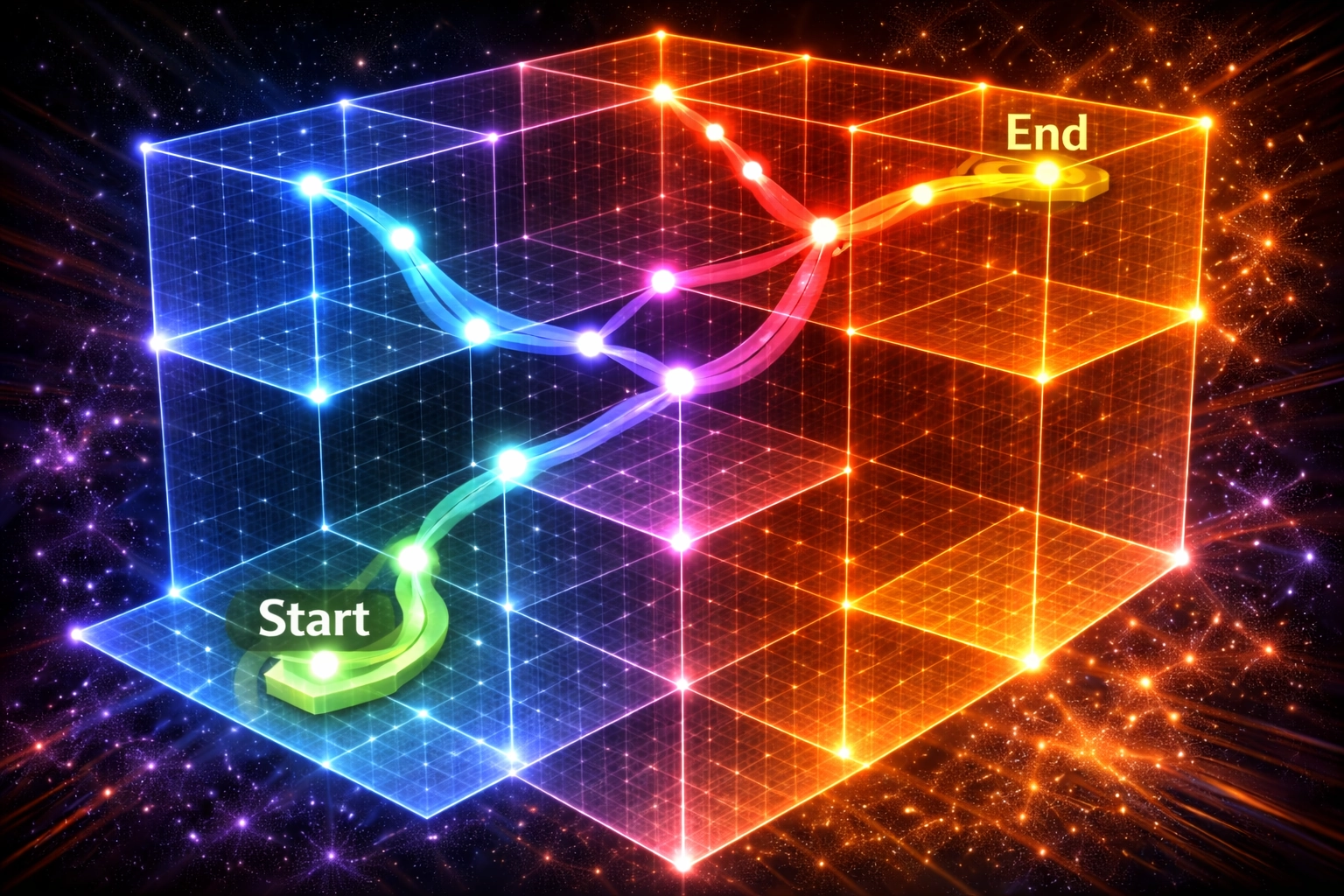
So translating this through to a our path-finding analogy, the motion towards the goal requires sliding along the various axis' adjusting which translate into motion towards and optimal counter-strategy. The "obstacles" are in-fact the negative space of the player's strategy and the goal is the optimally balanced enemy strategy calculated from a complete picture of the player's forces.
I have a lot of work cut out for me to make this a working and viable system but I'm so far satisfied with the early framing I've already accomplished.